Everything We Want. All the Time. Always.

After returning home from SxSW Interactive last week, I began thinking about some of the major themes I heard from this year’s speakers and panelists. Now with an event as large as SxSW, a person’s perspective will vary depending on what events and sessions he or she goes to. That being said, I think it’s fair to say that it is still possible to find a prevailing direction or theme that hangs in the air and touches all attendees. It is this overall theme that describes where the great minds presenting at SxSW think the world is headed. After some thought, I would say that the prevailing theme at this year’s festival was Big Data and Analytics. In non-nerd terms, the concept of Big Data and Analytics refers to the collection and analysis of massive amounts of data from a wide variety of sources. By studying this data, it is possible to identify patterns in human behavior and in turn, better predict what people will do or want. Assuming the best-case scenario, the proper use of Bid Data would result in products and services brought to you that are specifically tailor to your likes and dislikes, both online and in the real world, Features like Amazon.com’s “Products Recommend For You”, and Netflix’s “Recommended Movies” would play a major role in every aspect of your life. Big Data and analytics already play a big part of our lives. Most major retailers (Target, Walmart, etc.) use some form of analytics to tailor what products we see. Both major US political parties use analytics to maximize fundraising and predict voting patterns. Indeed, the 2012 re-election campaign of President Obama was a case study in the effective use of Big Data and analytics. If the speakers of SxSW are to be believed, the use of these tools will expand to all areas of our lives.

What would the widespread use of Big Data and analytics mean for our everyday lives? In the best-case scenario, it would mean each person see a world largely designed around them. Where ever you go, you will know what stores have exactly what you want, what places you would like, and what restaurants serve your favorite meals. You will be able to surround yourself at all times either with existing friends or people who you should like (based on your predicted preferences). There will be no need to settle for anything less than what you want. In fact, there’s a high likelihood that you will only see those things you DO want. Indeed, many of the day-to-day compromises and annoyances that are part of life will be eliminate.

Given that we seem to be moving in this direction, now would be a good time to ask a few questions about the impact this new world would have on humanity. Is the human race built for a world where we get everything we want? How will this new way of living impact our ability to live together? From a Christian standpoint, what does God’s Word have to say about humanity and its response to world largely devoid of challenges and compromise?

While not specifically delving into the details of Big Data, the New Testament does have something to say about this issue. In Romans, Paul speaks to the young Christian church in Rome. Here, Paul spell out the basics of the Christian faith, as neither he nor any of the Apostles had met with the members of this church before. Part of his letter addresses dealing with difficulty:

1 Therefore, since we have been justified through faith, we have peace with God through our Lord Jesus Christ, through whom we have gained access by faith into this grace in which we now stand. And we boast in the hope of the glory of God. Not only so, but we also glory in our sufferings, because we know that suffering produces perseverance; perseverance, character; and character, hope. And hope does not put us to shame, because God’s love has been poured out into our hearts through the Holy Spirit, who has been given to us.

Romans 5:1-5

Here, Paul points out that suffering, while painful, is necessary for personal growth (character) and spiritual maturity (hope). Without this disappointment, it is impossible for us to become the people God made us to be. Put differently, getting everything we want can be bad for our health. This same issue is addressed by the Apostle James:


Consider it pure joy, my brothers and sisters,[a] whenever you face trials of many kinds, because you know that the testing of your faith produces perseverance. Let perseverance finish its work so that you may be mature and complete, not lacking anything.

James 1:2-4

Like Paul, James stresses the important role that troubles play in the development of Christians. Our ability to become mature Christians (and better people) is linked to our exposure to problems and challenges. During tough times, we rely on our faith in God and our belief that He will deliver us from our current predicament. When He does deliver us, our belief in Him is strengthened, and we learn that through our faith in God, we can endure more than we could before.

How does all this tie to the Big Data/Analytics-driven world described at SxSW? One could argue that problems and challenges enter our lives only when we don’t get things our way. Difficulties enter our lives when we are forced to see things we had no desire to see, and experience things we didn’t want to experience. One of the primary drivers behind the use of Big Data and Analytics is to distill the all options in world around us to only the things that we want (and will likely buy).  If the world around us is tailored made for our enjoyment, we lose our chance become strong. It’s the equivalent of joining a gym with no weights or equipment. Humans only get stronger with resistance training.

What’s your take on Big Data and Analytics?
Sound off in the comments!!!
Innovation and Christianity

SONY DSCDuring my time at SxSW, a common theme throughout the conference was the need for two things – innovation and good design. Innovation is needed to create unique solutions to longstanding, complicated problems. Good design (be it for web sites, products, or software) is essential for the user adoption of any new tool. People generally are hesitant to adopt things that are hard to use. When we do use products that are onerous, the result is generally a high number of complaints and a low amount of productivity. Indeed – the ability for us to solve of many of the problems we face in the future is dependent on innovative minds and good design. With that in mind, it occurred to me that there is one group who should be particularly well-equipped to come up with innovative solutions that are expressed with well-thought out design – Christians. Now I know most people don’t associate a religion that goes back more than two millennia with cutting edge solutions. This is especially true with fact that many believe that to be a Christian requires a person to be anti-science or anti-technology. Let me explain…

New innovations, like a work of art, reflect the mindset of the person (or people) who created it. To be innovative and to produce well-designed products, it is necessary for the creator to have a certain perspective of the world around him. A certain mindset is required. In order to be a person who is innovative, one must be able to see unique connections between disparate things. One must also be able to understand how different things work, not so much on a technical level, but moreso in the sense of cause and effect. While a technical solution may not be transferable from one problem to another, the cause and effect relationship between things is frequently transferable from across many types of problems, regardless of the technology. While these skills are critical to innovation, I would propose that there is a perspective that is more important than both of these skills to having an innovative mindset. That perspective is optimism. Without optimism, I would argue that it is impossible to be innovative. One has to believe that the problems they are facing are solvable. In addition, they have to believe that THEY are capable of solving these problems. One must have an optimistic (not unrealistic) outlook towards mankind and the future. Without this, few concepts would every get off the drawing board. The Christian faith is hardwired for an optimistic outlook towards the future. It is key to the Christian outlook that we live in a fallen world, separated from God, and that mankind is incapable of rescuing himself from his condition. It is also fundamental to the Christian understanding that through Christ’s death on the cross, we are not bound by sin and salvation is available. In addition to salvation, the indwelling of the Holy Spirit means that God is actively building His kingdom on earth today. This is a cause for great optimism that should shape the world-view of every Christian.

Just as an optimistic mind is necessary for innovation, empathy is necessary for good design. A good design can be generally described as the successful solution to a problem face by an end user or group. In order to come up with a solution for someone, a designer needs to understand the problem. This is what the area of design research is all about. Taking the time find out as much as possible about the all factors associated with problem you design is trying to solve. In addition, design research should also focus on the end user. It should identify the problems, concerns, and priorities of the people who will be using the product or service being designed. While a solid understanding of both the design problem at hand and the end user are critical to good design, I would argue that empathy is the most important factor. Hours upon hours of field research mean little if the designer does not care about the end-users’ plight. There must be a genuine concern for the end-user, born out of an effort to see the world from their point of view. This kind of compassion for others is fundamental to the tenants of Christianity. This is clear in Scripture from the Sermon on the Mount in Matthew Chapter 5 (“Blessed are the poor in spirit, for theirs is the kingdom of heaven…”) to the many examples of Jesus healing people, such as his encounter with the possessed man in Mark, Chapter 5 (“Jesus did not let him, but sad, ‘Go home to your own people and tell them how much the Lord has done for you, and how he has had mercy on you’” – Mark 5:19).

So why isn’t the Church a hotbed of innovation?  Or are there key examples of innovation within the Christian community? Share your thoughts in the comments…

Big Data & Algorithms – What We Want or the End of Free Will?

SONY DSCOne of the biggest brain-busters when it comes to Christianity is the concept of free will. Do we make our own choices or are we simply following a script that God created for us? Put differently – if God created us, and controls all of the individual factors that determine our preferences, do individuals really have the freedom to make their own decisions?

Don’t worry – I won’t try to answer those age-old questions in this brief blog post. I do, however, think it is worth spending a few minutes discussing the ongoing recording and digitization of our lives and it’s impact on our ability to make our own choices.

As we’ve discussed in earlier posts (link), one of the most important developments in the past 5-7 years has been the mass collection of data about every aspect of our lives. From where we are, what we buy, and what we look at online, to who we talk to and what we say. Increasingly, someone somewhere is recording that data. While it can be argued that this development is either helpful or harmful, the fact that this data is being collected isn’t in dispute.

Given that fact, it’s reasonable to ask, what the heck are they using all this data for?

The answer to this question is fairly simple. The personal data collected is being used to create algorithms. An algorithm is a formula (or group of formulas) that are used to predict the outcome of something. By collecting and analyzing raw data (like your buying habits, what you view online, or how and when you talk to others), it is possible to identify patterns that can be predicted by algorithms. The more personal data these organizations can collect and analyze, the more accurate they will be. Algorithms can be used to t predict group behavior on both a large and small scale. And they’re getting pretty good at it. A February 12th article in the New York Times reported that Target’s algorithms for predicting shopper behavior are so accurate that they can determine not only if a woman is pregnant, but how far along she is in her pregnancy. In one particular example, a father became alarmed when his teenage daughter began receiving mailers from Target for baby products. Only after complaining to his local Target store and then having an extended discussion with his daughter did he learn that she was actually pregnant. In a separate article, the New York Times also reported that Netflix used similar algorithms when putting together their new TV series “House of Cards”. The online video rental company analyzed the movies and shows their subscribers streamed most often. What they found was:

1. A large percentage of their subscribers streamed movies by the director David Fincher.
2. The original British version of the series “House of Cards” was also streamed in large numbers.
3. Viewers of both of the above also tended to stream films featuring Kevin Spacey.

With this information, Netflix constructed an online series consisting of exactly these three elements. The analytics were right on the money. Netflix’s “House of Cards” went on to be the most streamed piece of content in the US, along with 40 other countries.

Indeed – the science of web analytics is advancing to the point where it can be used to predict the outcome of anything.

That brings us back to our discussion of free will.

As more aspects of our personal lives are recorded and analyzed, those collecting this data will develop algorithms that are more and more accurate to better predict our behavior. As years and years of data accumulate and good algorithms are proven correct over time, it is reasonable to assume that the decision makers who use these algorithms will begin to look at the predictions with increasing certainty.

Given that these algorithms will increasingly have direct control over what we see, hear, learn, and buy, they will directly impact on our lives. Even before we’re born (see: Target Baby), these algorithms will alter the life options we see based on the choices of people demographically similar to us. As we move through life, this digital characterization of who we are will become more detailed, further editing the options available to us.

Just as religious scholars have long questioned man’s relationship with God, we must ask ourselves about the impact of an algorithm driven world and our ability to make choices.

Specifically – will it be possible for individuals to make independent choices, to make choices based on their own desires, in a world where algorithms control all the options that are available?

Or, is it possible that with well-constructed algorithms, we can produce a new, better world where what we want can be mathematically determined before we know we want it?

One thing is for sure – given the pace that data is being collected and the improving accuracy of algorithms, we will all learn the answer soon enough…

Share your thoughts in the comments…

We’re Off to SxSW 2013!!!

sxsw promo_small

We here at bytesandbelief.com are heading to Austin, TX this weekend to cover the 2013 SxSW – Interactive Conference!!!

SxSW (pronounced South by Southwest) is not really a conference in the traditional sense. Divided into three parts (Interactive/Film/Music), it’s really part Consumer Electronics Show, part Sundance Film Festival, and part music festival. SxSW is really the place where web developers, hardware engineers, and start-ups go to introduce their newest products. Many popular apps and services, such as FourSquare and Twitter, were first introduced at SxSW.

It’s is also the place where leaders in the technology industry go to discuss their vision of the future. While the goal of most sessions is to inspire the next generation of developers, things that are discussed here will eventually impact the tools we ALL use. What’s discussed here will heavily influence how we as a society decide to integrate technology into our lives.

What do the thinkers behind the technology movement think?
That’s the question we hope to shed light on over the next several days.

Check the site frequently for updates!

Installing the Digital Veil

In the time of Jesus’ birth, the structure of worship was pretty straightforward. There was one channel through which the people of Israel worshipped God. The high priests were the sole path to get to God. Sacrificial offerings made for forgiveness of sin had to be done through the high priest. Prayer requests went through him. Worship couldn’t occur without him. If a person wished to have right relationship with God, it could not happen without a relationship with the high priest. The life, death, and resurrection of Christ turned this all on its head. By offering salvation to all through His sacrifice on the cross, Christ allowed direct access to God for all who believed. The veil was torn (Luke 23:44-46), and the middle-man role of the high priest was made irrelevant. Worshipers were freed from a dependency on the high priest to make sacrifices to God for forgiveness of sin. By being the perfect sacrifice, Jesus’ death on the cross paid that debt forever.

Needless to say – this was kind of a big deal. Calling it a revolution would be an understatement. It changed the religious power structure. Before Christ sacrifice on the cross, the priestly class had control the eternal lives of their followers. And with that power, they could dictate the behavior of their followers in this life. That type of centralized power in any human hands will lead to abuse. Not only did Christ free us from sin, He also freed us from this type of oppression on earth.

Fast forward to another revolution. The creation of the personal computer in late 1970s brought an entire new set of capabilities into the world. Personal computers took the ability to perform complex and specialized tasks and put it in the hands of average people. This was indeed one of the goals behind the creation of the PC. Steve Wozniak, co-founder of Apple Computer and father of the personal computer once said:

“At our computer club, we talked about it being a revolution. Computers were going to belong to everyone, and give us power, and free us from the people who owned computers and all that stuff.”

Through computer software, such as word processors, spreadsheets, and databases, individuals could now perform complex tasks with professional looking results. Before PCs, large companies or individuals with specialized training were the only ones capable of doing these tasks. Imaging trying to design and print stationary, or trying to re-touch and develop photos in the early 1970s. For the average person at that time, the only way to do this would be to hire expensive specialists. Now, one person can do all these things independently, with limited experience and cost. As computers became more sophisticated, the ability of the individual increased, and more specialized fields and professions were disrupted.

This brings us to where we are today, with the advent of cloud computing. Cloud computing, to describe it simply, is the storage of data, software, and processing power in centrally located server farms. Put another way, the cloud is computing power held in centralized locations. Individuals gain access to this computing power via simple, low power systems via the Internet. The computers used by individuals to access this power aren’t capable of doing much without being connected to the Cloud. Conversely, the ability for an individual to do anything sophisticated would be dependent on his or her status with the Cloud. For example, both Microsoft and Adobe have transformed their bread and butter software offerings (Microsoft Office and Adobe Creative Suite, including Photoshop, Illustrator, etc.) into cloud-based apps. Access to these programs is available through a monthly service fee. Additionally, everything you create with these programs is by default stored on their remote servers. While both companies still offer full, “ownable” versions of their software, Microsoft and Adobe have made it clear that this is not the future of their business. They are not alone in this view. Companies such as Google, Amazon, and Apple all are re-orienting the direction of their companies towards cloud based products and services, including data storage and software.

The rise of cloud computing, when juxtaposed with these two previous revolutions, raises some interesting questions that are worth considering. What does it mean for the people when increasingly everything they create begins its life online? What does it mean for the people where increasingly all the digital tools they need to earn a living are only available through cloud-based services? What does it mean for the people where increasingly all of the artifacts of their lives (things they’ve made, photos of family and friends, cherished written memories) exist only in a digital cloud?

An argument can be made that we will have installed a digital high priest – a middleman through whom we must go through to accomplish much of the needed things of everyday life. While that may not make much sense now (“Hey – I can walk away from Instagram. It’s not that big a deal…”), walking away might not be so easy in the not-to-distant future, as more and more of our lives move online. Prior to the life of Jesus Christ, the high priests could use eternal damnation to control the earthly behavior of the Israelites. In a future where much of what we are and do will be dependent on cloud-based data systems, wouldn’t the owners of the cloud have that same type of power?

What’s your opinion? Share it in the comments!!!

If You Don’t Know, Now You Know: The Black Box in Your Car

snapshot-screenshot-small

This post is the first in an ongoing series here on Bytes & Belief.  The goal of “If You Don’t Know…” is to educate our readers on how data is being collected about them, many times without their knowledge. Regardless of whether you’re cool with it or creeped out by it, we all deserve to know when and how our behavior is being monitored.

For our inaugural post, I selected this article from our friends at the Electronic Frontier Foundation. It discusses the use of EDRs (Event Data Recorders) in today’s new automobiles. EDRs are small computers that connect and record real-time data about an automobile’s systems, such as current MPH, brakes and throttle position, and airbags.

While this data may be used for the proper operation of the vehicle, it can also be very valuable to others, such as insurance companies (“How often does this driver speed?”) and law enforcement (“Did the driver hit the brakes before the crash?”). EDRs are regularly subpoenaed during court cases. Insurance companies, such as Progressive Insurance, are using this data to set car insurance rates. And since the information is embedded in the auto manufacturer’s proprietary software, consumers DO NOT have access to this information.

As the EFF article explains, there are currently no regulations around what data can legally be collected and who is allowed access to it (For instance – auto companies could also collect your GPS location data). The National Highway Safety and Transportation Agency is currently proposing that EDRs be mandatory in all new vehicles by September 2014.

Check out the article and post your thoughts in the comments…

The Doctrine of Efficiency

The word doctrine, while having a very official and somewhat churchy ring to it, describes a fairly simple concept. A doctrine is a principle (or set of principles), which act as the foundation of one’s beliefs. A person (or a people’s) doctrine, describes what’s at one’s core – what he/she/they are really all about. The choices we make in life all spring up from our doctrine. Everyone has a guiding doctrine. I would argue that, because of technology’s advance into all aspects of our lives, the guiding doctrine of today’s world is increasingly becoming what I call the Doctrine of Efficiency.

One of the best examples of society’s persistent drive towards efficiency is the Internet itself. As it has evolved, the Internet has consistently moved in the direction of the increasing the efficiency of disseminating information. News and current events were communicated through a broad spectrum of print periodicals, available only through purchase or subscription. With the Internet, news from most, if not all sources is now available online. While some context is lost, and the barrier to reportingg false information has been lowered (vs. print media), the Internet delivers more news to more people in a format that is easily consumable. Another simple example is music. Purchasing a new album (Album? What’s an album???) from an artist on physical media (CD, Vinyl LP, etc.) was the primary means of distributing music prior to 2002. The Internet now makes the majority of mankind’s library of recorded music available via download. Consumers can now store hundreds of thousands of songs on single 3.5 inch hard drive. With physical media, a warehouse may be needed to store that much music. While the sound quality of downloaded music file may be slightly diminished when compared to the physical media version, digital downloads are a more efficient means of buying, storing, and consuming music.

The push towards greater efficiency (and the agreement to make certain trade-offs to achieve it) has been around since the founding of the first cities along the Tigris and Euphrates Rivers. The unspoken principle (or doctrine) that drives this push is that getting the most possible output for the minimal required amount of input is always best. Few would argue that this is a sensible, pragmatic point of view. Every new innovation from Silicon Valley is based on this belief. It’s a guaranteed formula for financial success. It’s a core tenant of mass production, and capitalism.

The advent of the microprocessor and Moore’s Law has switched the push for efficiency into hyper-drive. In the past 5-10 years, we as a society have faced with a tidal wave of new services, gadgets, and technologies guaranteeing to let us do more with less required of us. By and large, we have signed up for this trade-off, choosing to go the route of increased efficiency. And when applied to the correct circumstances, the Doctrine of Efficiency works. When it comes to selecting a new water heater, it works. When it comes to selecting a new car, it (arguably) works. But does it work just as well in selecting friends? In selecting a mate?

With the increased spread of the digital world into previously “analog” portions of our lives, we cannot help but be pushed into looking at the world through the “least in for the most out” formula. More and more of our activities are taking place in online environments. More and more of our decisions are being made with the help of computer-based tools, be they search engines or recommendations from websites or social media. These digital tools are being designed with the Doctrine of Efficiency at their core. As we increasingly use tools that prioritize efficiency above all else, then we in turn may begin to prioritize efficiency over all other considerations. What might this look like in practice?

– The best friends for me are those people who visit the sites I visit, buy where I buy, and live where I live.
– The best answer to my question is at the top of the search results.
The best use of government education funding is to spend more on those students most likely to do well.

While all these points of view may win the efficiency prize, they may also severely limit ones perspective, and produce some downright scary outcomes. How could the Doctrine of Efficiency impact a person’s understanding of the Christian message? How does one evaluate the actions of God relative to the this doctrine? That question brings to mind this passage from Matthew (18:10-14):

10 “See that you do not despise one of these little ones. For I tell you that their angels in heaven always see the face of my Father in heaven. [11] [a]

12 “What do you think? If a man owns a hundred sheep, and one of them wanders away, will he not leave the ninety-nine on the hills and go to look for the one that wandered off? 13 And if he finds it, truly I tell you, he is happier about that one sheep than about the ninety-nine that did not wander off. 14 In the same way your Father in heaven is not willing that any of these little ones should perish.

Risking the loss of 99 sheep for the sake of a single sheep may not be an efficient use of resources, but it is an example of the love God has for us. If society values pragmatism and efficiency above all else, the God described in Matthew will increasingly look irrational and unrealistic. How can one be the Creator of all things and think like that?

As we increasingly look at the world through the eyes of data and analytics, our doctrine will determine how we interpret that data. It will also determine if we look beyond what’s on a spreadsheet to make decisions. The Doctrine of Efficiency, while sometimes helpful, is not the rule to live by.

Disagree? Sound off in the comments…

Your Privacy, the Internet, and What’s at Stake…

SONY DSC

“Gmail reads all my email. Why should I care?”
“Facebook tracks what I do online. So what?”
“My iPhone tracks my location – big deal. I don’t have anything to hide.”

These are typical responses that people give when they are told that their privacy is at risk when they are online. This might indeed be the attitude of many reading this post. People have a hard time seeing what the big deal is when it comes to sharing (what seems like) insignificant details of their lives with corporations. These corporations are providing them a valuable service for free, so its seems like a fair trade, right?

Worst caseI’m forced to sit through advertisements that are selected “just for me”

This new article on Scientific American’s site The Rich See a Different Internet Than the Poor gives the most clear, succinct explanation I’ve ever seen of what is at stake when it comes to internet privacy. In layman’s terms, they explain how the massive amounts of data that’s being collected by these services is being used to shape everything we (and don’t see) in both the virtual world and real world. I can go on about it, but I doubt if I could explain it as clearly.

Regardless of where you sit on the issue of internet privacy, we all need a clear understanding of what’s at stake. This article is a must-read.

Want to talk more about it? Sound off in the comments!

The Creator’s Burden

SONY DSC

I was talking to a software engineer at an industry event a couple of weeks ago. The conversation drifted to what happens to a product after it’s released. I asked:

“Do you ever think about how the products we create will impact the people who use it?”
“Definitely. At (fill in company name here), our top priority is meeting our customer’s needs. We have whole departments who focus on that.”
“Okay – I hear you, but do you think about it personally? I mean, as engineers, it is our hands that do the work, so aren’t we ultimately responsible for what we design and the effect it has on others?”
“Well, you could say that. It’s just that at (fill in company name here), we are always trying to out-innovate our competitors. That’s what we hear from management, so that’s what we focus on.”

That last statement stuck with me well beyond the end of the event. I know (from first hand experience) that the continual message any engineer receives from his employer is “Innovate!”. “Add new features.” “Make it bigger/smaller, faster/lighter/cheaper.” “Beat the competitor.”. Even in college, engineers are regularly pitted against their classmates to design a better solution. The pressure can be pretty intense. On top of that, engineers tend to judge themselves by their ability to come up with the “best” solution. There is an innate drive among many engineers to one-up each other. The combination of the external pressure to outdo other companies and internal pressure to outdo each other tends to leave many engineers with a sense of short-sightedness. We frequently don’t do in-depth thinking about what happens to our creations beyond the final release date. Knowing this, I think its fair to ask:
What impact does all this “innovation” have on the end-user?
On communities?
On societies?
How will my creation impact the relationships between the people who use it?
Within families?

Keep in mind – I’m not talking about meeting regulatory, environmental, or safety requirements. I’m talking about other factors that are just as important, but harder to quantify.

Are today’s software engineers, hardware engineers, product designers, and computer scientists responsible for what they create?

From a Christian standpoint, the answer to this question can be found in Scripture. While there are multiple relevant passages, a key example for this discussion is Jeremiah 18:1-10. Here, God sends His prophet Jeremiah to a pottery workshop, and tells him to await His message. While at the workshop, Jeremiah observes the potter shaping and re-shaping clay on the pottery wheel (v. 1-5). At this point God, speaks to Jeremiah:

(v.6) He said, “Can I not do with you, Israel, as this potter does?” declares the Lord. “Like clay in the hand of the potter, so are you in my hand, Israel.”

Ever since Genesis 12:1-3 when God first spoke to Abraham, the descendants of Abraham have been known as God’s Chosen People. From Abraham, to Isaac, to Jacob (Israel), He was continually involved in their lives. God did not start the ball rolling with Abraham and walk away. In verse 6, God reminds Jeremiah that the future of the people of Israel is still in His capable hands. He is still actively involved in He started with Abraham.

God’s actions here are very instructive for engineers. We cannot simply stop paying attention to the products we create after the project ends. As people who bring ideas into reality, we must stay informed about the impact of our creations are having on the world.

The lesson continues in the remaining verses:

(v.7) If at any time I announce that a nation or kingdom is to be uprooted, torn down and destroyed, and if that nation I warned repents of its evil, then I will relent and not inflict on it the disaster I had planned. And if at another time I announce that a nation or kingdom is to be built up and planted, 10 and if it does evil in my sight and does not obey me, then I will reconsider the good I had intended to do for it.

In verses 7-10, God explains to Jeremiah how He evaluates and responds to a nation He has created. If a sinful nation repents of its evil, God will not dispense punishment on it. Conversely, God states that He will reconsider the good planned for a nation if the people sin and do not obey Him. Here – God shows that He does not simply stay informed about the things he creates. He acts based on what He sees. If His creation is not fulfilling its intended purpose, He responds. In the same way, we engineers must not only know the impact our creations are having on the world. We must act on what we learn. If we see that the products we create are having a negative impact on society, we must act.

This leads to what I call the Creator’s Burden. With both the advanced tools and intellectual gifts we have been given, we designers, engineers, and programmers are free to create anything our minds can conceive. And as a result of this freedom, there has been an explosion of new technologies, devices, and services in the past 20 years that has literally changed the world. But with that freedom, we must also accept the burden of keeping watch over our creations and their impact on the world around us. And if we learn that something we have created is having a negative impact on the world, then it’s our job to fix it.

It’s not Marketing’s job.
It’s not the job of the Sales Department.
It’s not your boss’s job.
The responsibility rests with us – the creators.

Let me know if you agree (or disagree) in the comments!!!

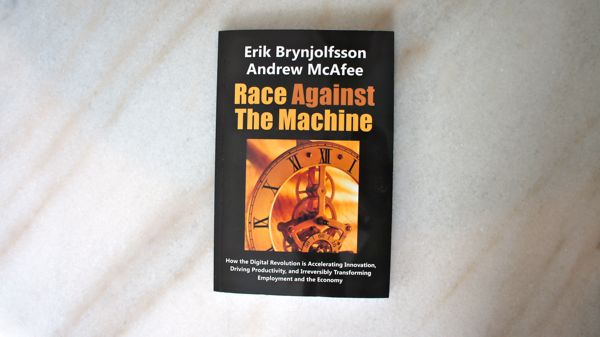
Book Review: “Race Against the Machines” by Erik Brynjolfsson and Andrew McAfee

SONY DSC

The book, while surprisingly brief, can be a bit obtuse for those who have a limited tolerance for acronyms. Despite this fact, the authors do a good job of describing the many facets of this complicated problem. They walk us through the economic downturns of the past 50 years, pointing out technology’s increasing involvement in each. The authors also explain the conspicuous absence of dialog about role of technology’s advance in the sluggish job growth of today’s economy.

Things get interesting when they begin to drive home the point that we have less time to solve this problem that we think. This is due to the exponential rate at which computing power is advancing. Everyone who has seen a science fiction movie like “The Matrix” or “The Terminator” has considered the possibility (however briefly) that people and computers may be in direct competition one day. Most people tend to dismiss those thoughts with the idea that these problems will take place in a distant future – preferably long after we’re gone. In Chapter 2 the authors, using Moore’s law as their foundation, dispel this belief. For those unfamiliar, Moore’s Law states that computing power doubles every 12-18 months. Since it was first introduced in 1965, Moore’s Law has been proven to be correct. This means that the capability of computers to perform complex tasks improves exponentially. To put it differently, this means the improvement in capability of the best processor of 1966 (after the start of Moore’s Law) would be double that of the best processor of 1965. Seeing that the amount of computing power of available in 1965 was small, doubling it in 1966 doesn’t mean much. Remember – the 1960s was still the era of punch cards and room-sized computers. As time progresses however, the incremental increase in computing power becomes staggering. The doubling in performance of a complex and powerful 2011 processor for example, means that the best processor in 2012 is profoundly more capable. This has a major impact on what a computer can do.

What does all this mean? It means that human tasks we thought a computer wouldn’t be able to for decades, like driving a car, are quickly within its grasp. Google was able to develop fully autonomous vehicle within 6 years. The authors point to IBM’s Watson supercomputer, which soundly beat human grand champions on the game show Jeopardy in 2011, as another example of computers being able to comprehend and reason in ways previously thought impossible.

Computers, as Brynjolfsson and McAfee point out, are a General Purpose Technology (GPT). GPTs are important because not only do they themselves improve over time, but they also cause other (previously unrelated) industries to improve as well. Think of it this way – a farmer in 1770 using a horse and buggy could bring his crop to market only so fast and so far. That same farmer in 1870, using a steam-engine powered locomotive, could both bring his crops to market faster and to markets further away. The steam engine improved not only the transportation industry, but the farming and food industry as well.

Just like the steam engine, computing technology is disrupting many industries, but there’s an important difference. Historically when a new GTP enters the scene, those whose employment is dependent on the previous mode of doing things lose their jobs. This downside is usually remedied by the economic growth resulting from the new technology. Those put out of work are retrained and eventually put to work in the new economy created by the GTP.

What makes the use of computer different from other GTPs, according to the authors, is that the computer is disrupting many different industries at an unprecedented rate. It is, in turn, displacing workers faster than the new digital economy can create opportunities for those who lose their jobs. And as the capability of new technologies increase exponentially (Moore’s Law – remember?), more workers will be displaced.  This leads to the position the US economy is increasingly finding itself in. A condition where there is economic recovery with little to no job growth.

So how do we create an economy with institutions that can allow for the rapid growth of technology and innovation without leaving large segments of the workforce behind? This is the core question posed by Race Against the Machine.

The answers offered by Brynjolfsson and McAfee, after such a solid definition of the problem, are a bit unsatisfying. By and large their recommendations are things we’ve heard before. The authors suggest more entrepreneurship – with a particular focus on small businesses that address niche markets made viable by new technology.  They also recommend increased training for people put out of work, and increased investment in infrastructure and education. The fact that Brynjolfsson and McAfee don’t describe in detail how these recommendations will address the problem of worker displacement points to the complexity of the issue.

Erik Brynjolfsson and Andrew McAfee, both graduates of MIT and members of the faculty at the Sloan School of Management, are far from being members of the Tinfoil Hat Society. In fact, they make a point of being very pro-innovation and pro-technology throughout the book. And it is because of this that their message should be listened to. Their book makes the point that the digital revolution is profoundly changing both the economy and society at a rate never seen before. Race Against the Machine underscores the need to begin a discussion of the potential fallout of these changes. If we don’t, our world may wind up in a predicament that technology won’t be able to help us out of.

Have you read this book?
Please share your thoughts in the comments…